IN THIS LESSON

Native California history & harm reduction through time.

A brief overview of Native California history, and how harm reduction has always been practiced on these lands. Though harm reduction may not be what it was called, the beliefs, values, and source of connection has always been here.

Below, you will find a brief overview of important historical and cultural context, an interactive timeline, and a brief history of the War on Drugs.
Historical Context

  • Native communities in California have always been diverse, unique, and culturally distinct. Each tribe has its own history and examples of harm reduction that are unique to their own experience. While this historical section cant cover the history of everyone, it will cover a general timeline of some of the major events and how people responded.

    The landscape of California Indian Country now also includes the largest Native population of any state, with a large portion being urban Natives and people from tribal communities outside of California. This toolkit is intended to be useful for both California tribal and urban Native communities alike, and we will also include the context of urban Native community.

  • Since contact, there have been multiple waves of systemic violence towards California Natives. This includes cultural suppression, genocide, erasure, and countless unspeakably atrocious events. Throughout all of these instances of systemic violence, Native communities in California have always protected themselves and one another. While the struggle to fight against systemic violence continues, so does the inter-communal care and acts of love that have existed here for much, much longer.

  • Culture-keepers have had to hide knowledge, pass it down in secrecy, and risk their lives to continue cultural traditions throughout most of recent post-contact history. Generations of resistance have protected and revitalized cultural ways that have been systemically oppressed. It is because of their profound sacrifices and commitment to protecting cultural ways that so much of this knowledge has survived. No matter whether you’re California Native, an urban Native from elsewhere, or non-Native, this history needs to be known.
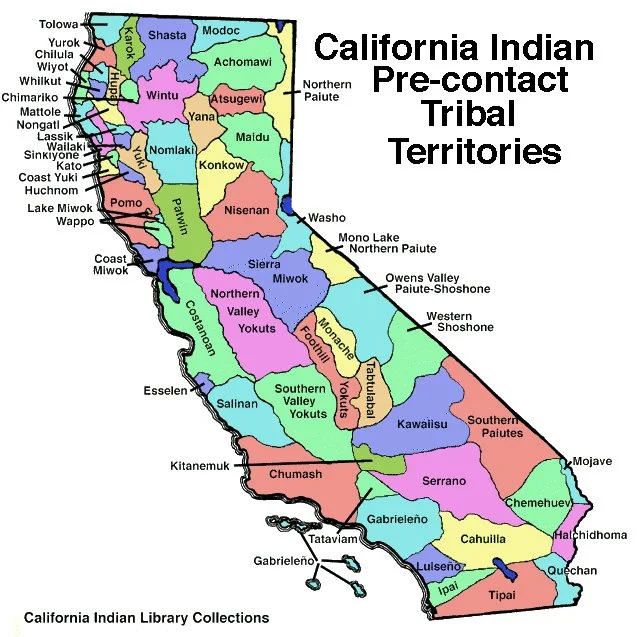

  • Pre-Contact

    “California” history didn’t begin with the mission system. Pre-contact, Native California was a diverse, widely populated, and each independent nation had their own unique systems of governance, cultures, languages, and lifeways. “California” at the time was not empty or a wilderness, it was the homelands of hundreds of tribal peoples, among some of the oldest cultures in the world. Every nation have their own histories and stories pre-contact. The fabric of California Native peoples included fishermen, weavers, singers, dancers, medicine people, canoe builders, storytellers, caregivers, tradespeople, dreamers, jewelry-makers. Creation stories show the origins of tribal peoples on their homelands from the beginning of time: rooted in the land, spiritual worlds, and ancestors. While every nation was unique, people tended to care for one another as a community rather than small family units or in fractured pieces. Children were raised with the support of the entire community; younger people would chop wood and get food for elders; an entire nation was responsible for one another, for passing down cultural teachings, for ensuring one another was supported. The cultural and social fabric of Native California was one of deep love and responsibility.

  • Early Settlers + Mission Era

    While genocidal settler-colonialism attacked Native communities across the continent, California has a distinct history sometimes invisibilized by the more mainstream narratives. California’s history of settler-colonialism began with the arrival of Russian and Spanish explorers, bringing with them an intial wave of disease and the initial disruption to California Native lifeways– earlier contact took place in the 1500s, gradually growing as “explorers” expanded their range of interest.

    In the 1700s, the Spanish Crown claimed the land known as California as their own. The transition of Spanish presence from explorers to settlers marked the beginning of even greater catastrophe. Spanish colonization intended to fully assimilate California Natives into their culture through the mission system: violence, coercion, forced displacement, concentration camps. 

    Those imprisoned by the missions were forced into hard labor and enslavement. By destabilizing California Native lifeways, disrupting family systems, and implementing genocidal policies, the mission system represents a deep source of pain that continues to impact California Native families to this day. The full scope of horror done during this era may never fully be known, but so are the legacies of cultural resistance to the mission system. Secretly passing down cultural knowledge in hushed whispers, escaping the missions in the middle of the night, fighting back against the missionaries, and working in intertribal solidarity to defend land and lives are just a few of countless ways that California Natives survived and protected future generations through unimaginable atrocities.

  • Mexican Era

    The Mexican era ousted Spanish control of “California” in the early 1800s. At this time, many California tribes had experienced generations of violence within the mission system. The Mexican era continued much of the same legacies in different forms, focusing on expansion of land grabs through develop ranches and creating land parcels for new settlers. American trappers and traders from farther east began encroaching into California Native territories, establishing their own settlements. The Mexican era launched a boom of commercial trade and commerce, facilitating further displacement and relocation of Native peoples. With the collapse of the mission system, some displaced tribal peoples returned to their homelands to find them fundamentally changed or overrun by settlers. At this time, California Native peoples continued to resist occupation and cultural genocide while navigating an abruptly changing landscape.

  • American/Gold Rush Era

    The transition from Mexican to American periods in the 1840s was marked by an even stronger influx of settlers to California. The US military began operating an Indian Affairs agency to “manage” California tribes. Shortly into  the American period, settlers discovered gold in the Sierra Nevada foothills. 

    While the Mission era is characterized by cultural loss, imprisonment, and widespread death, the Gold Rush era is characterized by an attempted genocide against California Native peoples on an incomparable scale. Within the first year of gold being “discovered”, over 100,000 settlers rushed into California to find their fortune, bringing not only disease but active hatred towards Natives for “being in the way”. These gold rush settlers organized government-funded death squads which led massacres and kidnappings, murdering children and elders indiscriminately, severing entire lineages of families, and sometimes killing entire tribal communities. Villages were burned to the ground, sacred sites pillaged, landscapes blasted by water cannons in search of gold, and open bounties placed on Native peoples. This is also when boarding or residential schools – institutions designed to forcibly remove and assimilate Native children – were designed and began to be implemented. The survivors of the gold rush genocide and beginning of the American period endured horrors beyond comprehension, deeper trauma than anyone should have to experience. The survival methods of California Native peoples – hiding far from home, trying to pass as other ethnicities, witnessing countless deaths and tragedies – are accompanied by the strength, resilience, and collective care it took to endure these apocalyptic events. The survival of cultural knowledge to this day is evidence of the deep networks of care, the determination to protect future generations, their resistance against settler-colonialism, and the love they had for their people.

  • Allotment and Termination

    During the late 19th and early 20th centuries, California Native tribes were rarely federally recognized, with most tribal peoples staying far from Americans and/or engaging in warfare against the remnants of settler death squads. Communities were scattered, and people suffered deep hardships related to loss of land access, foodways, cultural sites, and ceremony. In 1857, Congress passed the General Allotment Act. For the areas recognized formally as Native land, the government began dividing these into parcels and assigning small sections to individual Native families. In most instances, these small parcels were unfit to survive on, and the settler interests such as the government or businesses began buying up all available parcels. This led to land grab siphoning around 100 million acres from tribal communities.

    After the end of the allotment era in the early 20th century, Bureau of Indian Affairs attempted to end all services for California tribal peoples and transfer “governance” to the state of California. The Rancheria Act of 1958 introduced a new policy of coercing and manipulating tribal peoples into ending their own recognition, specifically targeting smaller or more isolated populations. This formally disbanded over 50 tribes within a handful of years, thus ending access to the few external resources they had. Termination was an act of planned chaos and disorientation that stripped the rights from dozens upon dozens of tribes. Several tribes have since successfully regained federal recognition, but many continue to struggle for restoration to this day.

  • Relocation

    As California Natives navigated the chaos of termination, tribes from within the state and all across the United States were pushed to move to urban areas by the 1956 Relocation Act. Native people across the U.S. were promised job opportunities, housing, or stipends in exchange for leaving their reservations or homelands to urban centers like the San Francisco Bay Area, Los Angeles, Minneapolis, or Oklahoma City. In California, San Francisco, Oakland,  and Los Angeles absorbed hundreds of Native families. Once they arrived, they found none of the promised opportunities existed. Through the isolation and displacement of the Relocation Act, an Urban Native identity began to form; intertribal Urban Native communities began to form kinship, build intertribal centers, and build social networks which withstood the new challenges faced in the urban environment. In spite of the Relocation Act’s intention to forcibly assimilate and disrupt people’s connection to their cultural identity, Urban Natives created a new form of intertribal community while still maintaining cultural and familial ties to their homelands. Today, California has some of the largest populations of Urban Natives in the country, with around 90% of the Native people living in California live in an urban center.

  • Alcatraz/Red Power

    In the 1960s, pockets of Native identity began to flourish and intermix. As distinct youth cultures among other ethnic groups began to grow through politicization, the Red Power Movement bloomed as a social current of cultural reclamation, taking back tribal autonomy and sovereignty, and community education. Out of this time rose organizations such as the National Indian Youth Council and the American Indian Movement (AIM). 

    In 1969 in the San Francisco Bay Area, Native students and extended community occupied Alcatraz Island, a former federal prison. For 19 months, they created a sovereign society with a full kitchen, childcare, healthcare, and ceremony with, at times, over 400 people living on the island. Though there were internal struggles, disagreements, and state repression, this was a pivotal moment in Native activism and Native history which continues to shape and inspire generations today.

    In the 1970s, tribes along the Klamath and Trinity Rivers fought against the government’s harrassment towards Native fisherman in a time known as the California Fish Wars or Salmon Wars. Yurok, Hupa, and other tribal peoples along these rivers fought to have their fishing rights honored through sit-ins/fish-ins, widespread protests, and fishing in defiance of the military-style occupation of these rivers. The fight to restore waterways and tribal sovereignty was a fight for the health and wellbeing of the entire community.

  • Cultural Resistance

    Cultural resistance is an ever-present factor of Native life in the state. Across California, Native communities are working on language revitalization, basketweaving, the defense and protection of sacred sites, reawakening cultural fire, organizing to bring down dams and restore salmon runs, bring back ceremony, fight for hunting and fishing rights, and spread the truth of California Native history and futures. California Natives traveling to stand in solidarity with other movements, such as the fight against the Dakota Access Pipeline and other sacred sites protection, are mere examples of the ways resistance and community care are alive and thriving today.

The War on Drugs: From Plymouth Rock

For Native peoples, the War on Drugs began with Plymouth Rock. The deepest harm done to our communities is colonization and its after-effects. Colonial forces facilitated unhealthy relationships to substances like alcohol for the purpose of manipulating our tribal leaders, fracturing our community structures, and destabilizing us as nations in order to extract land and life. After introducing and coercing these ancestors into unhealthy relationships to drugs and alcohol, these same colonial entities began policies of punishment, mass incarceration, and racial stereotypes intended to build social stigma and isolation. Creating the problem, and then blaming people for being affected by it, defines the nature of this cyclical violence. While this initial wave of the War on Drugs broke apart communities and lead to generational pain, our communities from California and beyond began their response to this new social problem. Ceremonial leaders, medicine people, and cultural doctors have worked since the beginning of this cycle to bring healing and wellness to our communities; however, ceremony and traditional lifeways were also heavily targeted and criminalized by the same colonial powers. The cycle continued:

  1. Drugs and alcohol pushed onto Native peoples for nefarious purposes

  2. Native people criminalized for using drugs and alcohol

  3. Native people struggling with addiction turn to ceremonial leaders

  4. Ceremony criminalized, culture-keepers targeted

  5. The pain and trauma of addiction plus cultural suppression grows

  6. People with fewer healing options rely on drugs and alcohol to cope

The 1980s War on Drugs is a method of social violence which is a successor and expansion of what had been done to Native people for hundreds of years. The War on Drugs efforts of the 1980s and beyond expanded incarceration rates which were disproportionately targeted towards Black, Native, and other communities of color. These patterns of harm are why drugs and alcohol use in our community is not an individual failure, but a symptom of the structural violence that began in 1492.